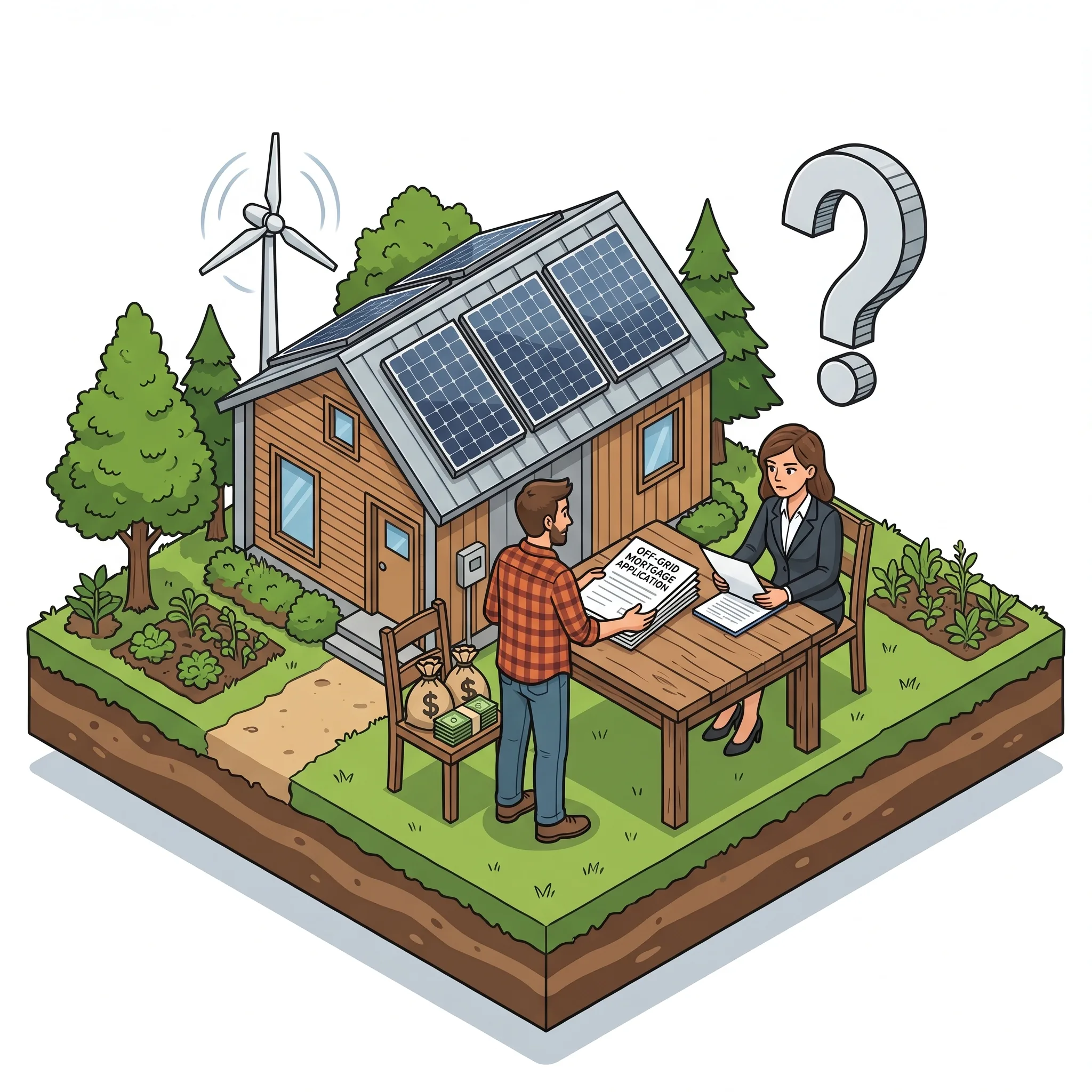
A claim circulates online that Fannie Mae will back a mortgage on an off-grid home: you just need a conventional loan and 20% down. The claim comes from real homeowners with real mortgages, but the details are usually wrong in ways that matter if you are trying to buy.
Here is what research into Fannie Mae's selling guide, FHA requirements, lender programs, and real borrower experiences actually shows.
Fannie Mae does not explicitly ban off-grid, but effectively excludes it
Fannie Mae's Selling Guide (Section B4-1.3-04) requires that "the utilities of the property must meet community standards" for a loan to be eligible for purchase or securitization. The guide does not use the phrase "off-grid" anywhere, and it explicitly allows private wells and septic systems when public utilities are unavailable.
The barrier is electricity. In the section on properties with solar panels (B2-3-04), the guide states that "the property must maintain access to an alternate source of electric power that meets community standards." This language presumes grid access as a baseline: a property with no grid connection and no utility-standard backup fails this test.
In practice, appraisers, lenders, and mortgage industry professionals consistently interpret "community standards" as requiring access to grid power. The industry consensus, documented across appraiser forums and lending guides, is that conforming loans backed by Fannie Mae or Freddie Mac are not available for truly off-grid homes.
When someone online claims to have a "Fannie Mae mortgage" on an off-grid home, the most likely explanation is a portfolio loan from a local bank, a loan the bank keeps on its own books rather than selling to Fannie Mae. Borrowers often do not know (or do not distinguish) whether their loan was sold on the secondary market.
What a portfolio loan is and why it matters
A portfolio loan is a mortgage that a bank or credit union originates and holds in its own portfolio rather than selling to Fannie Mae or Freddie Mac on the secondary market. Because the lender keeps the risk, it can set its own underwriting criteria: including accepting properties that do not meet conforming standards.
For off-grid homes, this is the primary financing path. Local community banks, credit unions, and Farm Credit lenders are the institutions most likely to offer portfolio loans on off-grid properties.
The trade-off is cost. Portfolio loans for off-grid homes typically carry:
- Higher down payments: 25–35% rather than the conventional 3–20%. Some lenders add 5% per disconnected utility (power, water, sewage), which can push the requirement to 30–35% for a fully off-grid property.
- Higher interest rates: Approximately 1% above prevailing market rates. When conventional 30-year rates are 7%, expect 8% or more on an off-grid portfolio loan.
- Shorter terms: 10–20 years is common, versus the standard 30-year fixed. A 15-year term may carry a lower rate and partially offset the off-grid premium.
Which lenders actually finance off-grid homes
Local community banks and credit unions are the strongest path. They evaluate applications case by case, know regional property values, and often have staff who understand rural and alternative living. Some credit unions, including EastRise Credit Union in Vermont, explicitly offer off-grid mortgage programs. Start with institutions in the county where the property is located.
Farm Credit lenders, AgWest Farm Credit, Farm Credit West, and similar institutions, specialize in rural residential financing and explicitly serve properties without grid water, power, or septic. They are portfolio lenders by structure and comfortable with non-standard properties.
Specialized mortgage companies exist in markets with established off-grid communities. Dimond Mortgage in Taos, New Mexico has deep experience financing Earthships and off-grid solar and cistern homes, leveraging local comparable sales that most lenders cannot find.
National banks, Chase, Bank of America, Wells Fargo, will not lend on off-grid homes. They sell loans on the secondary market and cannot accept non-conforming properties.
Government-backed loans: more nuanced than commonly claimed
A common claim is that FHA, VA, and USDA loans are completely unavailable for off-grid homes. The reality is more nuanced.
FHA loans do not explicitly prohibit off-grid homes. FHA requires functional water and sewage systems, and private wells and septic systems are acceptable under HUD Handbook 4000.1. For electricity, FHA allows solar electric power as long as it is used to power the residence. The biggest practical barrier is the backup heating requirement: homes relying on solar heat or wood stoves must have permanently installed conventional heating systems that can maintain at least 50 degrees Fahrenheit in all living areas. A fully off-grid home heated only by wood may not qualify, but one with propane backup could.
VA loans have documented success cases for off-grid properties. VA Minimum Property Requirements focus on safety, soundness, and sanitation rather than requiring specific utility types. At least one borrower has obtained a VA loan for an off-grid property in Colorado. However, VA appraisers are strict about utility functionality during inspection, and some lenders require proof of potential grid connection.
USDA Rural Development loans are worth investigating for eligible rural borrowers. USDA incorporates FHA property standards by reference and offers zero-down financing for qualifying low-to-moderate income buyers in eligible areas. The property must meet safety and habitability standards, but private wells and septic are explicitly permitted.
None of these programs is a guaranteed path for off-grid financing, but dismissing them entirely overstates the restriction.
The appraisal barrier
Even when a lender is willing, appraisals frequently kill off-grid transactions. Standard appraisal methodology requires comparable sales of similar properties within the same market area within the past 12 months. Off-grid homes rarely have comps.
The consequences are significant. Appraisers may value off-grid energy systems at zero. A solar and battery system costing $15,000 or more can receive zero contributory value if the appraiser has no paired sales data to justify an adjustment. Some lenders require the appraisal to include the estimated cost of connecting to the grid, effectively treating grid connectivity as a floor for collateral value.
Strategies that help: find an appraiser with green or sustainable property certification, provide three or more documented comparable sales before the appraisal is ordered, and obtain a Home Energy Rating System (HERS) audit to document energy cost savings. In markets with established off-grid communities, parts of New Mexico, Vermont, Alaska, and the Pacific Northwest, comparables are easier to find and appraisals are more supportable.
Alternative financing paths
When mortgage lending is not available, buyers use other options.
Owner (seller) financing is the most common alternative. The seller acts as the lender, the buyer makes payments directly, and no bank approval or appraisal is required. Typical terms include 10–30% down and a 3–10 year duration with negotiable interest rates. The risk: the seller retains legal title until full payoff, and if the seller has an upstream mortgage and defaults, the buyer can lose the property despite making all payments. Always require title insurance and a recorded land contract.
Home equity or HELOC on an existing property sidesteps the off-grid underwriting problem entirely: the collateral is the existing home, not the off-grid property.
Construction-to-permanent loans finance the build phase and then convert to a permanent mortgage. Portfolio lenders and Farm Credit institutions offer these for off-grid builds, but the borrower typically needs 20% or more down, finalized plans, and contractor documentation.
Practical steps for buying off-grid
-
Start with local lenders. Contact community banks and credit unions in the property's county directly, not through a mortgage broker, who typically accesses the same national lender pools that decline off-grid applications.
-
Budget for 25–35% down. The conventional 20% down payment rarely applies to off-grid properties.
-
Get a grid connection quote before making an offer. Many lenders require it regardless of whether you plan to connect. A utility company estimate costs nothing and prevents a deal-killing surprise at appraisal.
-
Identify comparable sales before the appraisal. If three or more off-grid homes have sold in the area within the past year, document them and provide them to your appraiser.
-
Secure insurance quotes early. Mortgage approval depends on insurability. Remote properties far from fire stations or homes with non-standard heating can be difficult or expensive to insure.
-
Consider a 15-year term. The rate is typically lower than a 30-year, which can partially offset the off-grid premium.
The bottom line
Off-grid homes are financeable, but not through the channels most homebuyers expect. Fannie Mae and Freddie Mac conforming loans are effectively unavailable. FHA, VA, and USDA programs have more flexibility than commonly claimed but come with property-standard requirements that not every off-grid home meets. The realistic path is a portfolio loan from a local bank or credit union, at a higher down payment and interest rate than a standard mortgage.
The financing landscape is gradually improving as off-grid building becomes more common and comparable sales accumulate in established markets. But today, buying an off-grid home requires more cash upfront, more legwork finding a lender, and more patience with the appraisal process than a conventional purchase.